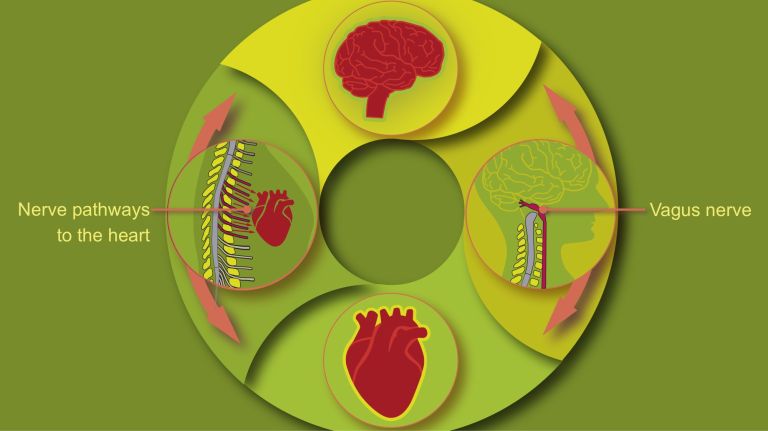
The Heart

For Aristotle, the heart was the seat of the soul. No wonder, since – unlike the brain – the heart reacts noticeably to intense Emotions. And so it can race – but also be made of stone. The heart can be pure, be given away, be followed, and it can break, as well. Although the brain plays the leading role in all these processes, try replacing the protagonist – it just doesn’t feel right.
On the other hand, the heart plays an important role for the brain. Not only does the brain’s immediate health depend on it: the healthier the heart is, the healthier the brain is. Please take this as an encouragement to engage in endurance sports! Stress, too, has a direct impact on the heart. The best-known condition is probably broken heart syndrome, but there are several others. Even at the cellular level, there are striking parallels, which is why the young discipline of neurocardiology views the heart and brain as a single system – and, for example, studies them at all levels at the Cluster of Excellence for Multiscale Bioimaging in Göttingen.
In this feature, we take a look over the shoulders of neurocardiologists – you’ll find a good overview in the article ▸ More Than Just a Pump by Nora Schultz.
Emotions
Neuroscientists understand "emotions" to be complex response patterns that include experiential, physiological, and behavioral components. They arise in response to personally relevant or significant events and generate a willingness to act, through which the individual attempts to deal with the situation. Emotions typically occur with subjective experience (feeling), but differ from pure feeling in that they involve conscious or implicit engagement with the environment. Emotions arise in the limbic system, among other places, which is a phylogenetically ancient part of the brain. Psychologist Paul Ekman has defined six cross-cultural basic emotions that are reflected in characteristic facial expressions: joy, anger, fear, surprise, sadness, and disgust.